Practice a skill.
Find your next step.
Guided DBT practice, a daily diary, and tools for a hard moment. Start with on-device tools; add optional AI conversation when you want to talk.
Free skills, diary & crisis kit · Ages 18+
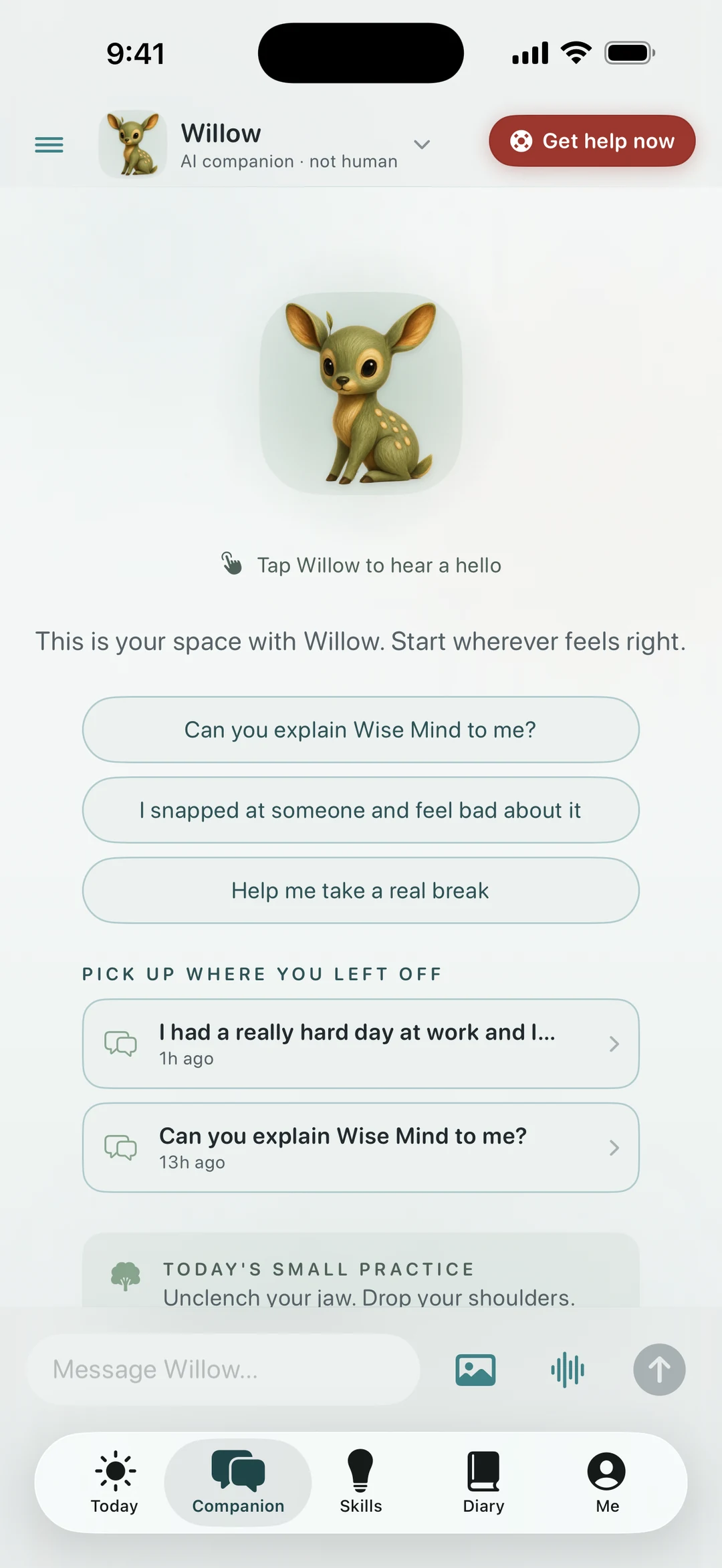

Practice, record, and reflect.
After the acknowledgement and adult confirmation, open the DBT tools with AI sharing off. No profile or companion setup is required.
-
Practice a skill
Start a guided Wise Mind practice from Today. Follow its steps and choose Log & finish to record the practice on your diary card.
-
Keep your daily card
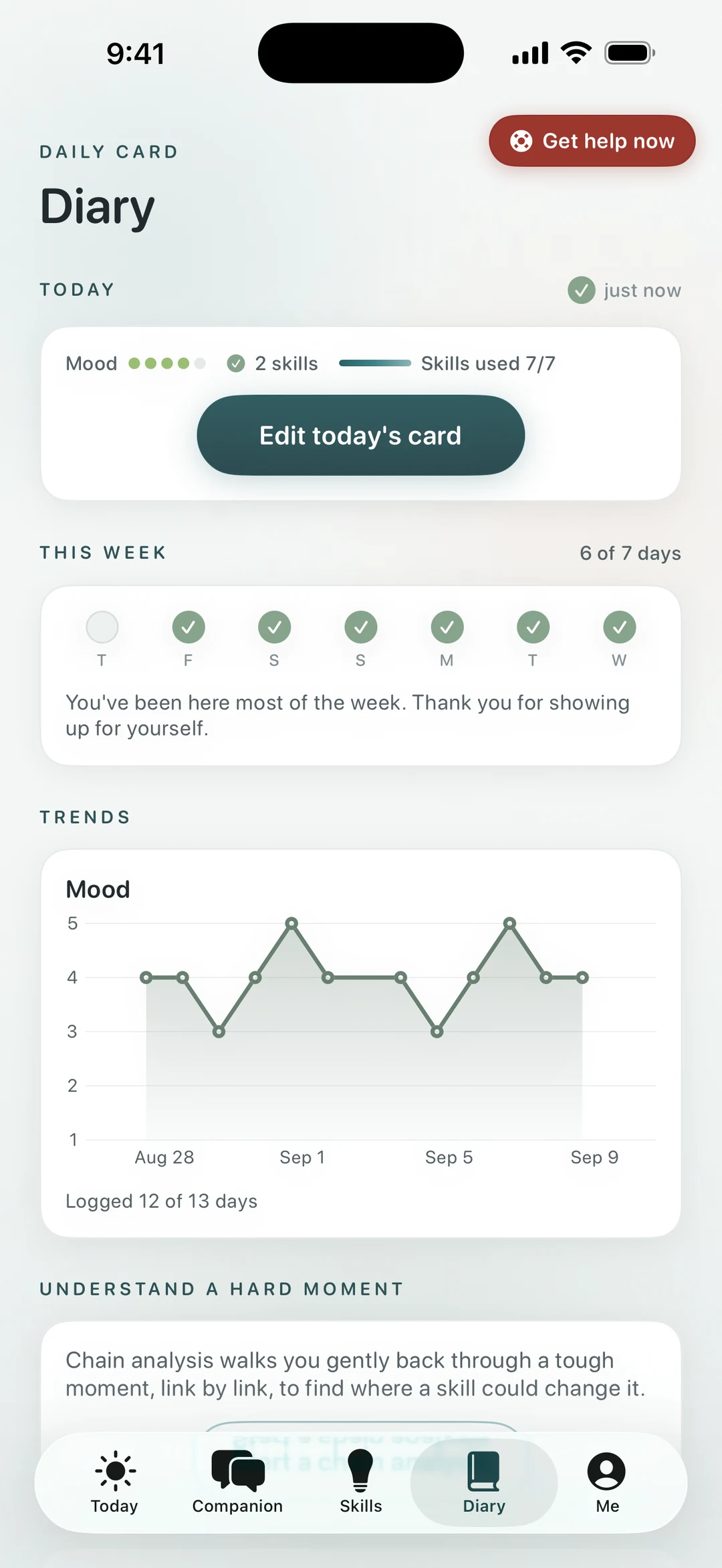
Record emotions, urges, skills and a note. Reopen your saved card and look back at your patterns over time.
-
Work through a hard moment
Trace a prompting event, the links that followed and what you would try next time. Save the written chain locally; asking for an AI reflection is a separate choice.
Choose the one who fits you.
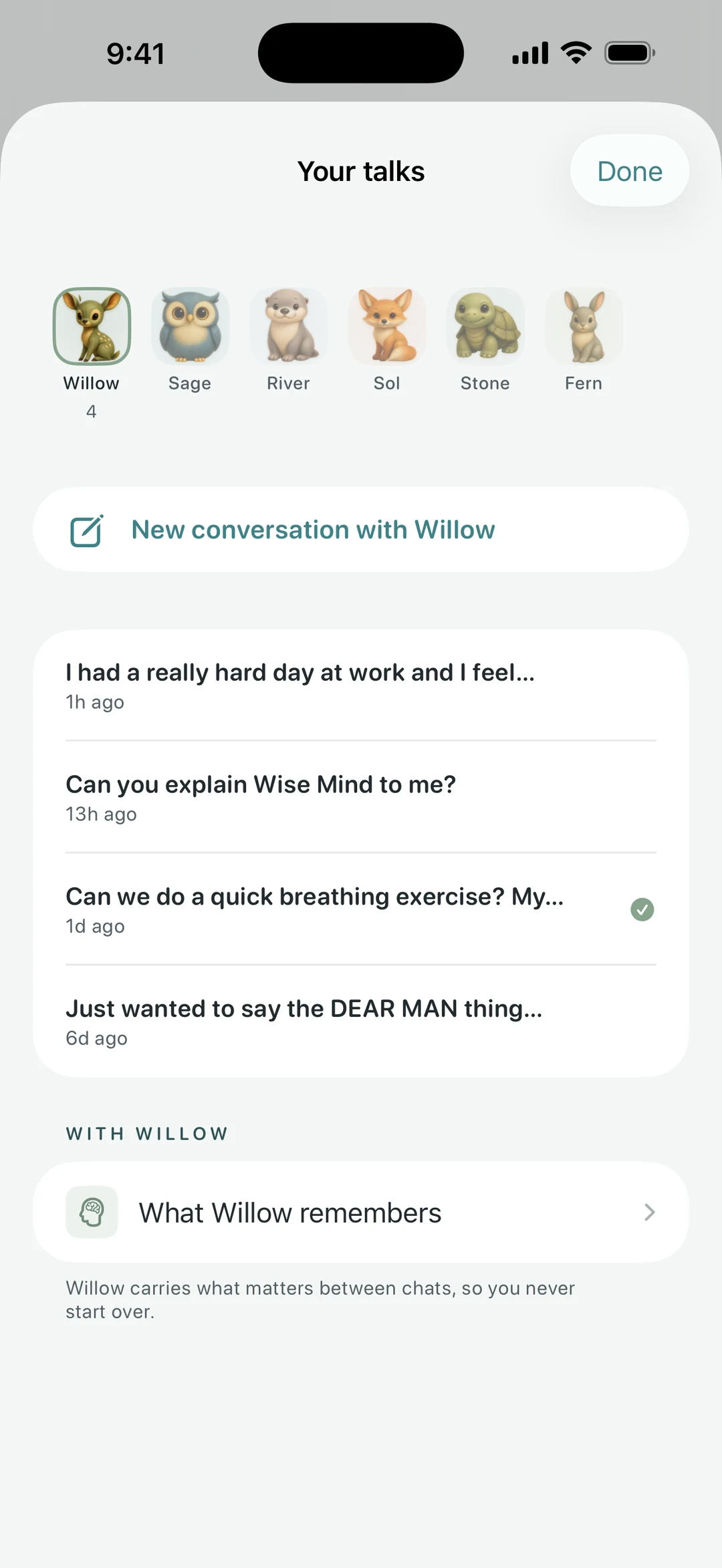
Meet Willow, Sage, River, Sol, Stone, and Fern, six nature spirits who live under the quiet oak. The one you choose guides your practice and stays with you when things get heavy.
Choose a companion to see them move. Tap Hear to meet their voice.
Warm and quiet. Starts with your feet on the floor and one slow breath, before anything else.
Read Willow’s introduction
Hi, I'm Willow. Whatever you're carrying right now, we can set it down together for a moment and just breathe.
Calm and plainspoken. Names what's going on, so it stops feeling like a mystery.
Read Sage’s introduction
I'm Sage. When things feel like too much, we'll find one small, doable next step — and take it together.
Curious and easy to talk to. Asks before it assumes, and keeps things conversational.
Read River’s introduction
Hey, I'm River. There's no wrong way to start — just tell me how today's going, and we'll take it from there.
Encouraging, never peppy. Helps you find one small, real thing to hold on to, without talking you out of the hard part.
Read Sol’s introduction
I'm Sol. Even on the heaviest days, we can find one warm thing to stand on. I'm glad you're here.
Unhurried and solid. Sits with you without rushing to fix anything, and says the least of the six.
Read Stone’s introduction
I'm Stone. We've got time. Nothing here has to be fixed right now — let's just take one breath, and then the next.
Soft-spoken and kind. Takes the pressure off first. Everything else can wait.
Read Fern’s introduction
I'm Fern. You don't have to be okay right now, or fix anything. Let's just be gentle with whatever this is.
Real samples from the app, in each companion's own voice. AI companions, not human. In chat, these voices come with Plus. Guided audio uses them for everyone, free.
Choosing one isn’t a commitment
Switch whenever you like. Each companion keeps its own history with you, so you lose nothing by trying another.
Same conversation. Six different companions.
Tap a companion to see how they'd answer. These are real replies from the app.

Every companion knows the same DBT skills. What changes is how they bring them.
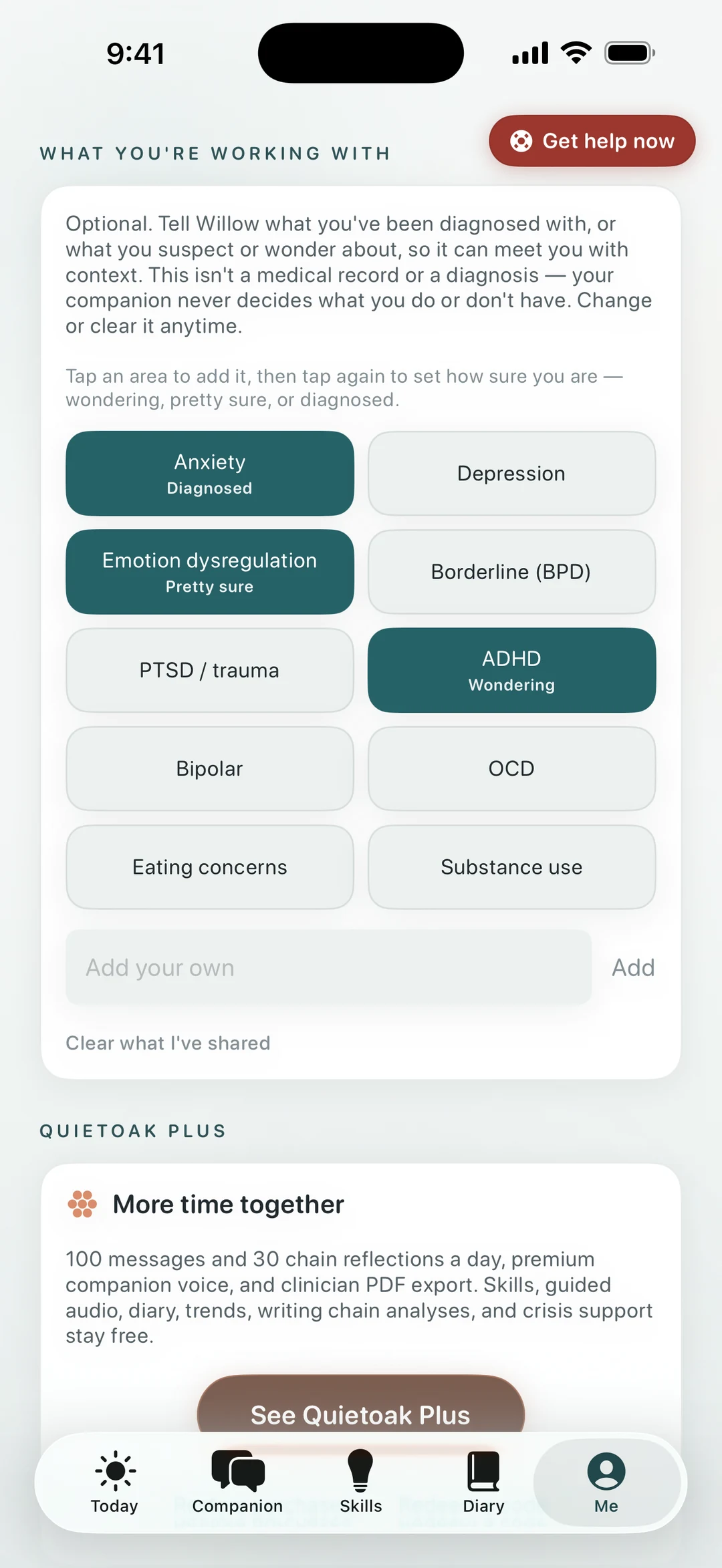
Tell it what you're working through.
Share as much or as little as you like. Your companion keeps it in mind, so you don't have to explain yourself twice.
- For self-help, not diagnosis. Optional context helps shape AI replies. AI can make mistakes; take diagnostic and treatment questions to a qualified clinician.
- However sure you are. Mark anything you add as wondering, pretty sure, or diagnosed. No proof needed, and all of it is optional.
- Yours to control. Change it or clear it whenever you like.
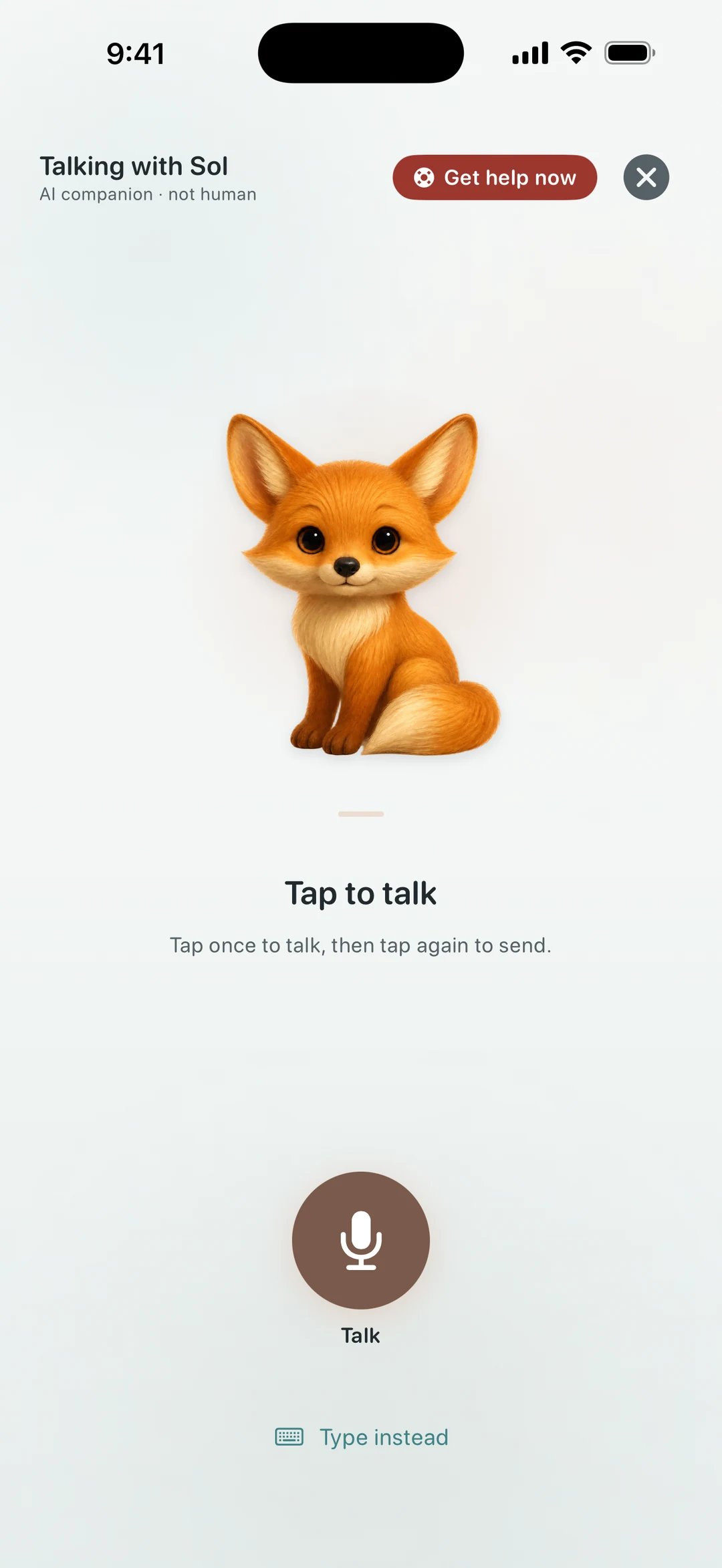
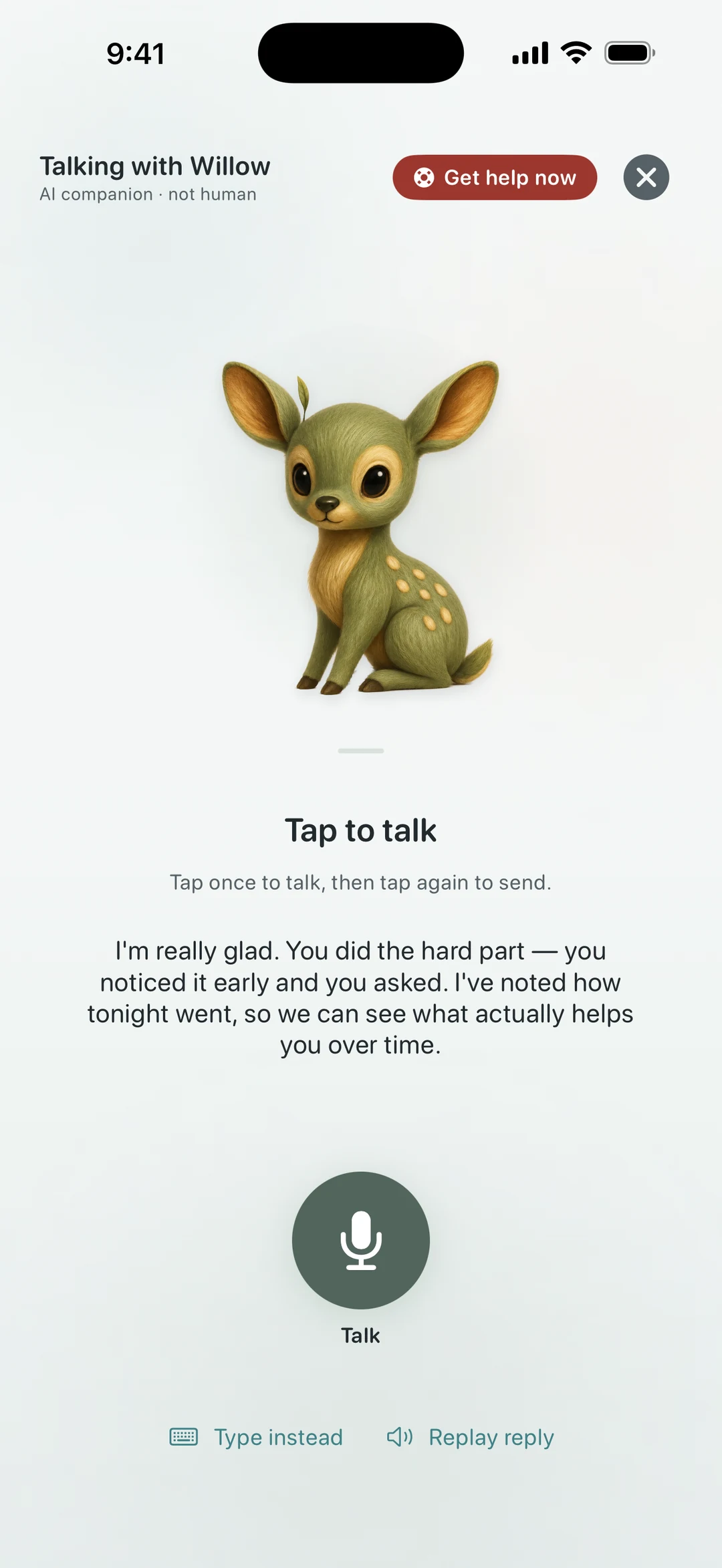
Some days, you'd rather just say it out loud.
When typing feels like too much, talk instead. Your companion answers in a warm spoken voice.
- Speak at your pace. Tap to start talking, then tap again when you’re ready to send.
- A voice that matches your companion. With Plus, each companion speaks in its own voice. Voice chat itself is free, using your iPhone's built-in voice.
- Always your choice. "Type instead" is one tap away, and so is the crisis kit.
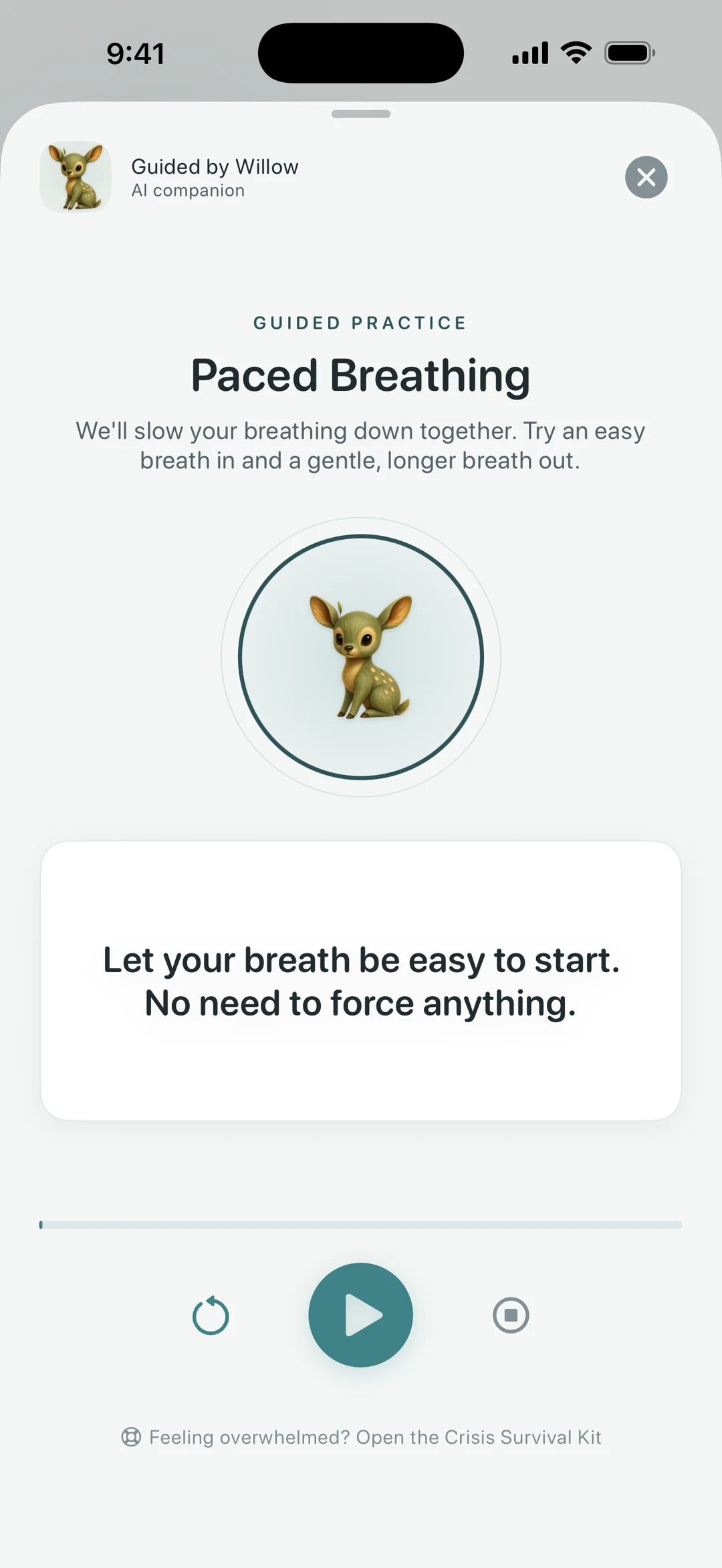
Your companion talks you through it.
STOP, TIPP, paced breathing, and a body scan, each recorded in your companion's own voice. Put the phone down, close your eyes, and follow along.
- The voice you know. Every exercise is recorded in all six companions' voices. Choose Stone and Stone walks you through it. Choose Fern and it's Fern.
- Free for everyone. Subscriber or not, you hear the same recordings.
- Works with no signal. The audio is stored in the app, so it plays the same on a train or in a hospital corridor as it does at home.
Read the audio excerpt
Settle into wherever you are. You don’t need to sit any special way.
If any part of your body feels like too much to visit today, just skip past it. You’re in charge of where your attention goes.
DBT skills, made gentle.
Practice eighteen skills across the four DBT modules, one small step at a time.

Six companions
Grounding, clear, flowing, hopeful, steady, or tender. Pick the one that suits you and give it a name. Your AI guide for daily practice and the hard days.

Real DBT skills
Wise Mind, Radical Acceptance, DEAR MAN, and the rest, each explained in plain, everyday words.

A one-minute diary card
A real DBT diary card. Rate your mood, emotions, and urges, log the skills you reached for, and type or dictate a note.

Guided exercises
STOP, TIPP, paced breathing, and a body scan. Follow each step on screen, or let your companion talk you through it out loud.

Crisis kit, always free
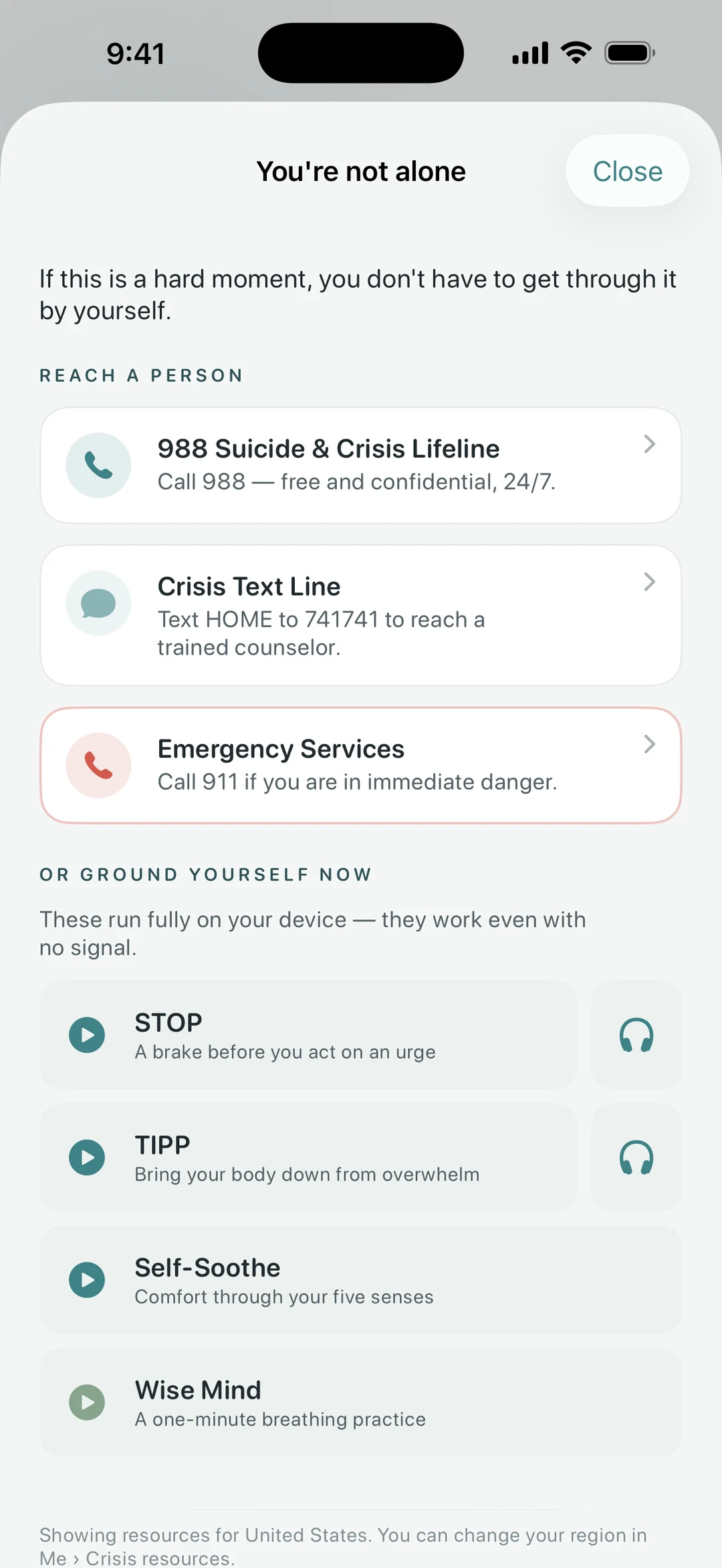
Regional resources and grounding tools, without a subscription. The directory works offline; placing calls, sending texts and opening websites require service.

Your diary, your space
Your diary and practice are stored on your device. You choose what to share with your companion, and you can clear saved conversations anytime.
Calm by day, gentle by night.
Warm, plainspoken screens in light and dark. Flip the switch to compare, and tap any screen to see it up close.
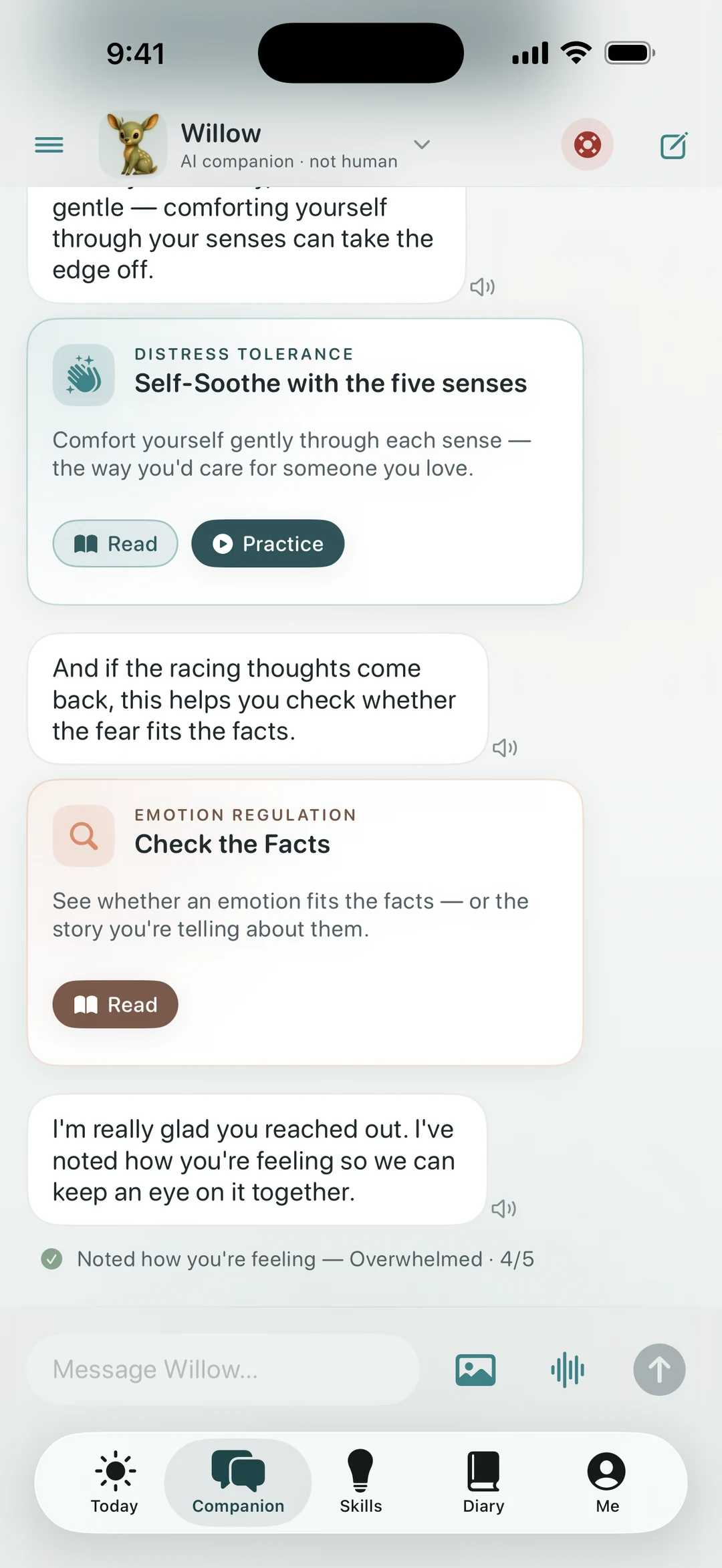
It listens first, and guides when it helps.
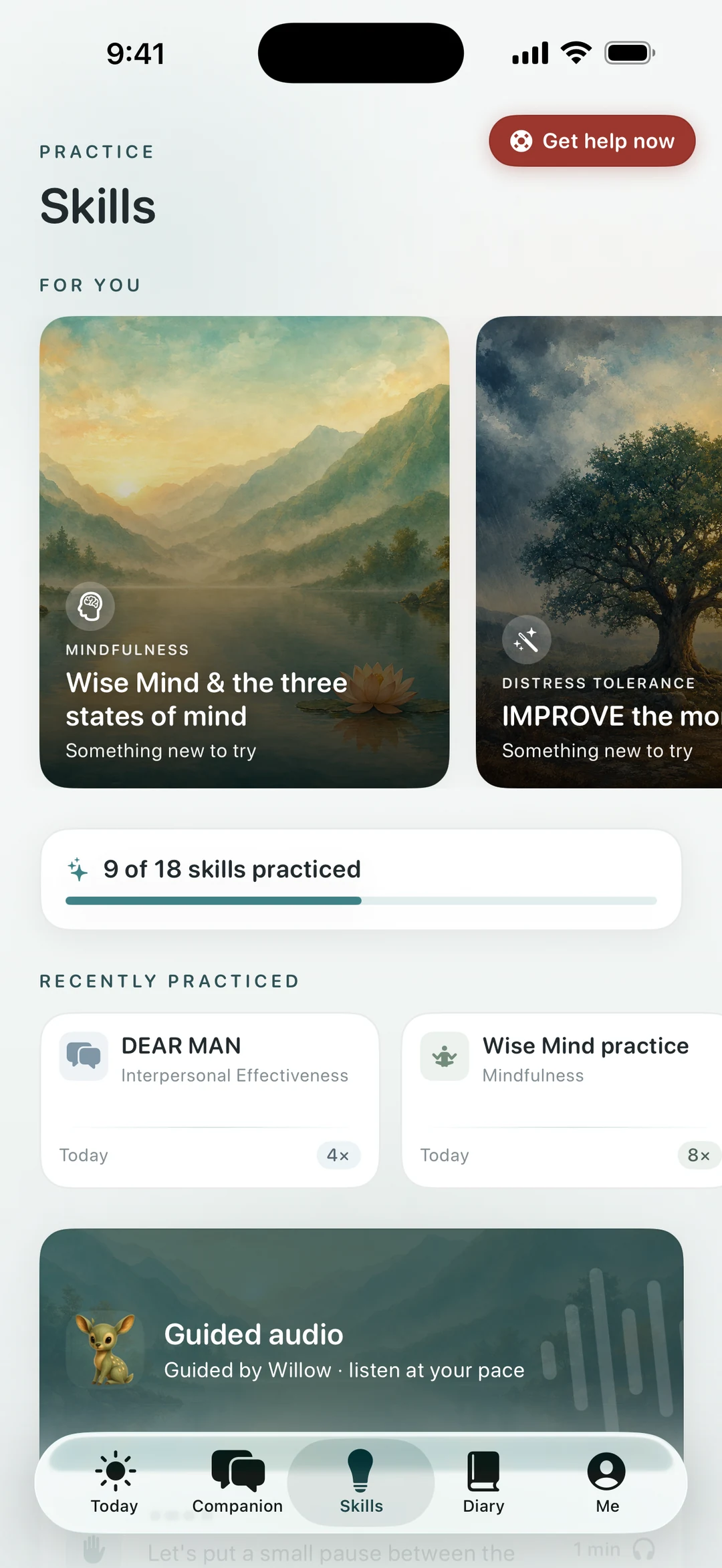
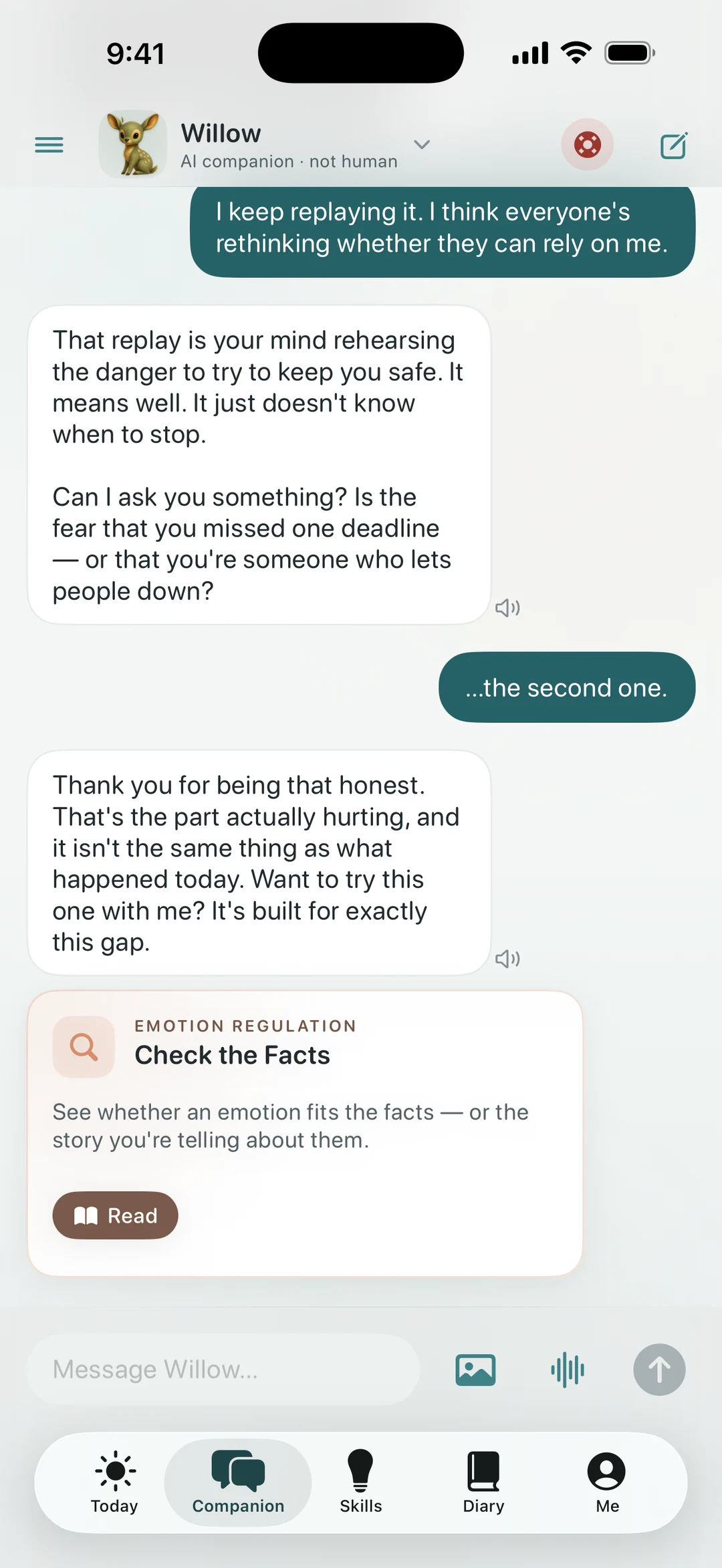
Your companion gives you room to say what’s going on, with your recent diary entries and conversations in mind. When a DBT skill fits, it brings the exercise right into the chat, and you can log it to your diary afterward.
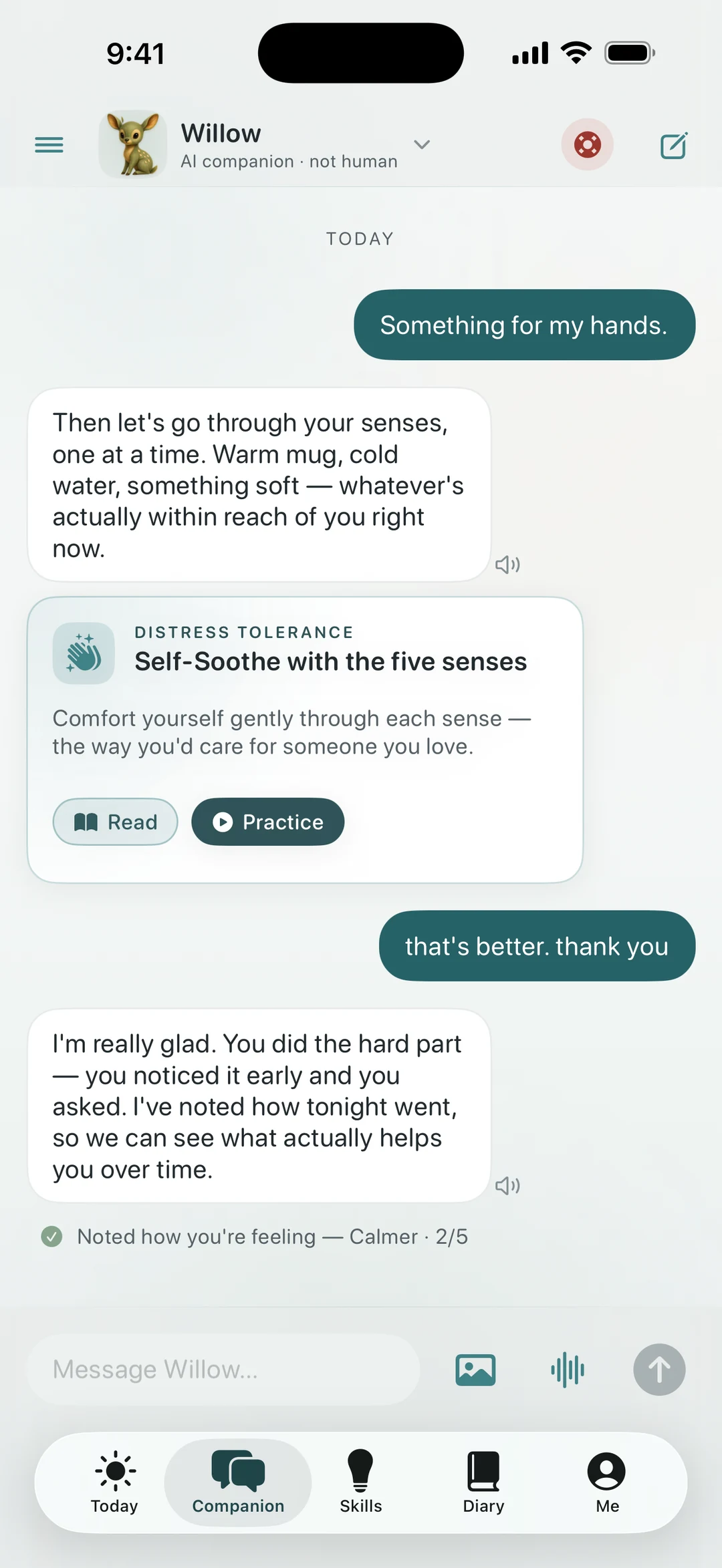
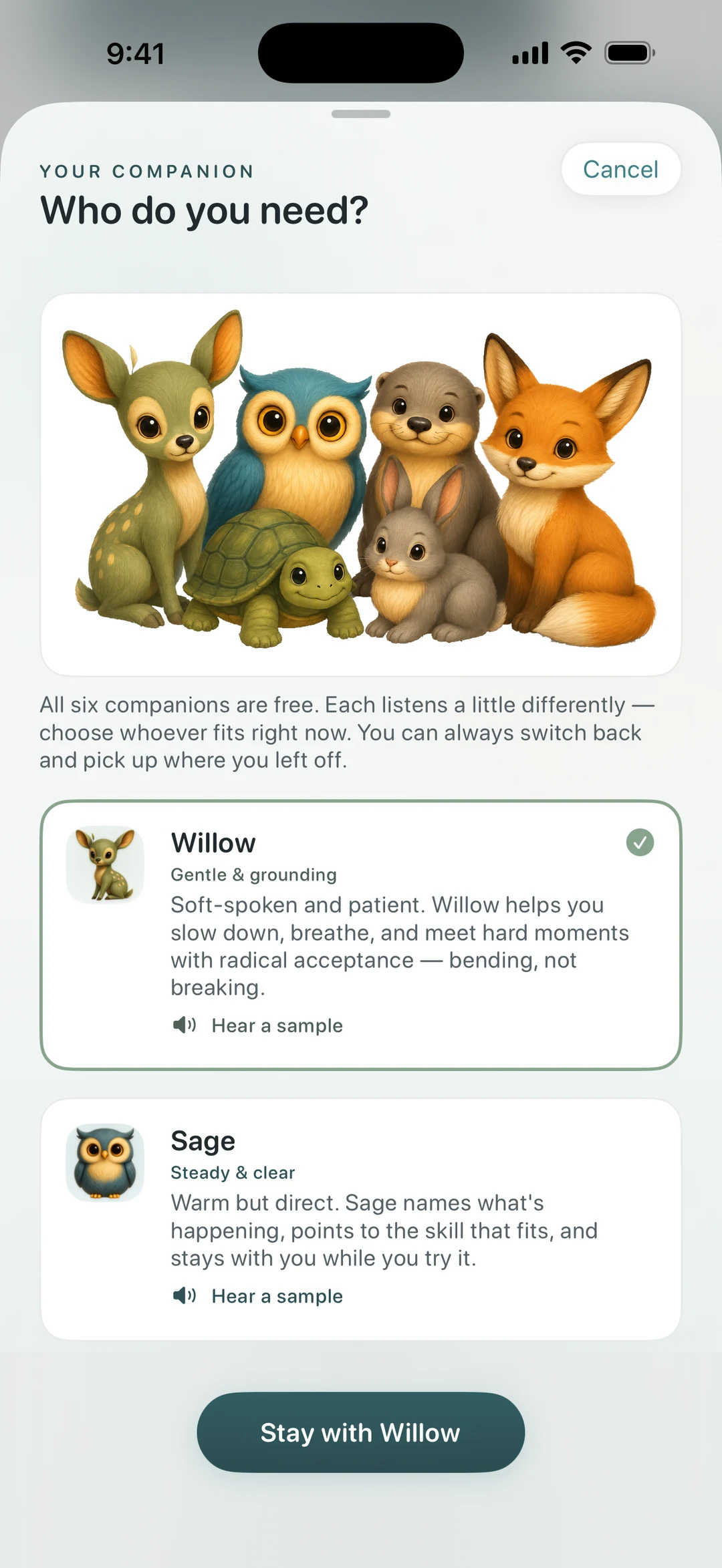
Whichever one you pick, it remembers you.
Each companion keeps its own conversations and knows what you've been working on. Switch away and back, and it's all still there.
- Picks up where you left off. Reopen any saved conversation and carry on.
- Switch anytime. Hear a voice sample first, then pick who you want to talk to.
- Yours, on your terms. Start a fresh talk or clear an old one in a tap.
The wins you'd otherwise miss.
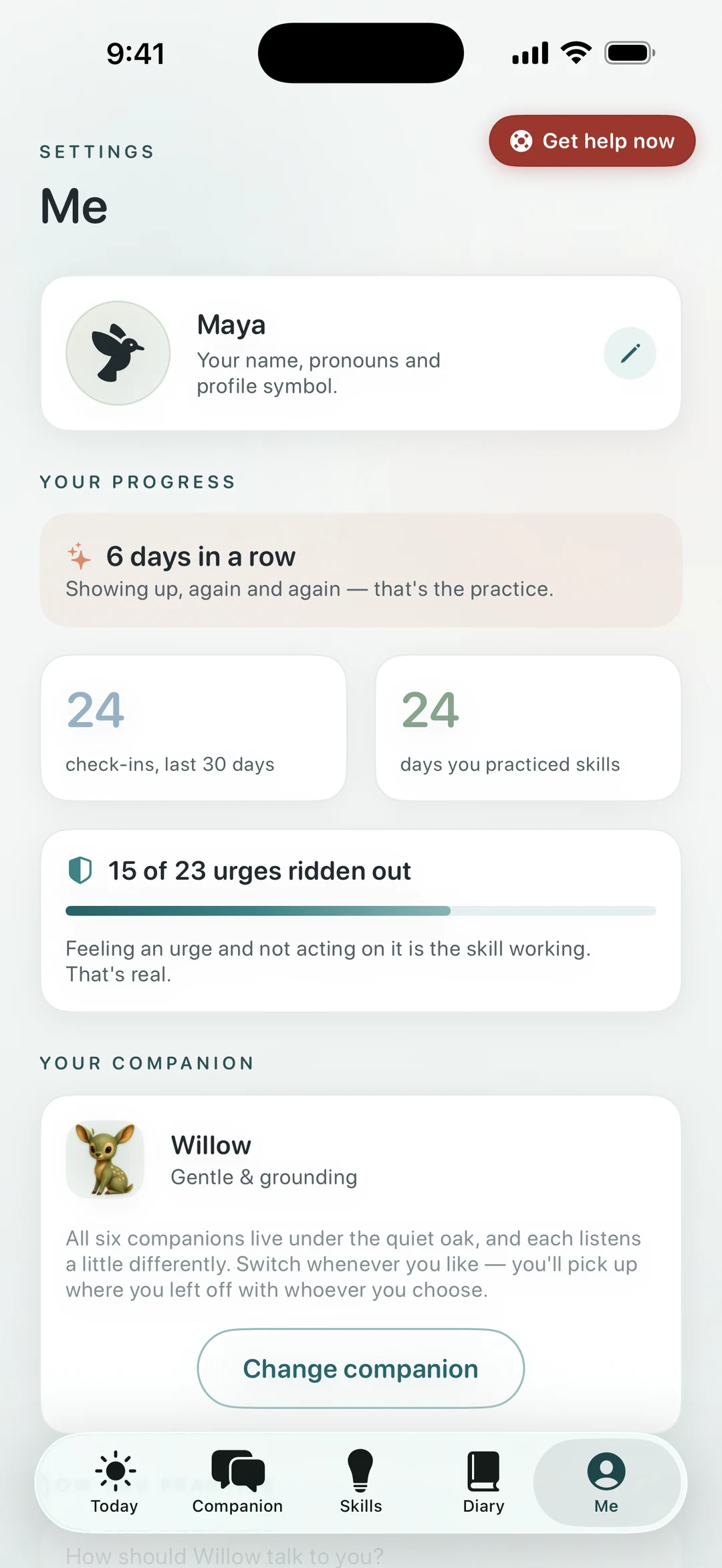
Progress isn't a straight line. Quietoak counts the quiet wins along the way.
- Every urge you ride out. See the times you felt an urge and didn't act on it.
- A kind streak, never a guilt trip. See the days you checked in. Miss a day and nothing scolds you.
- Patterns over time. Your mood and urges show up as calm lines, with your skill days counted alongside, so you can see what's helping.
Find the link you can change.
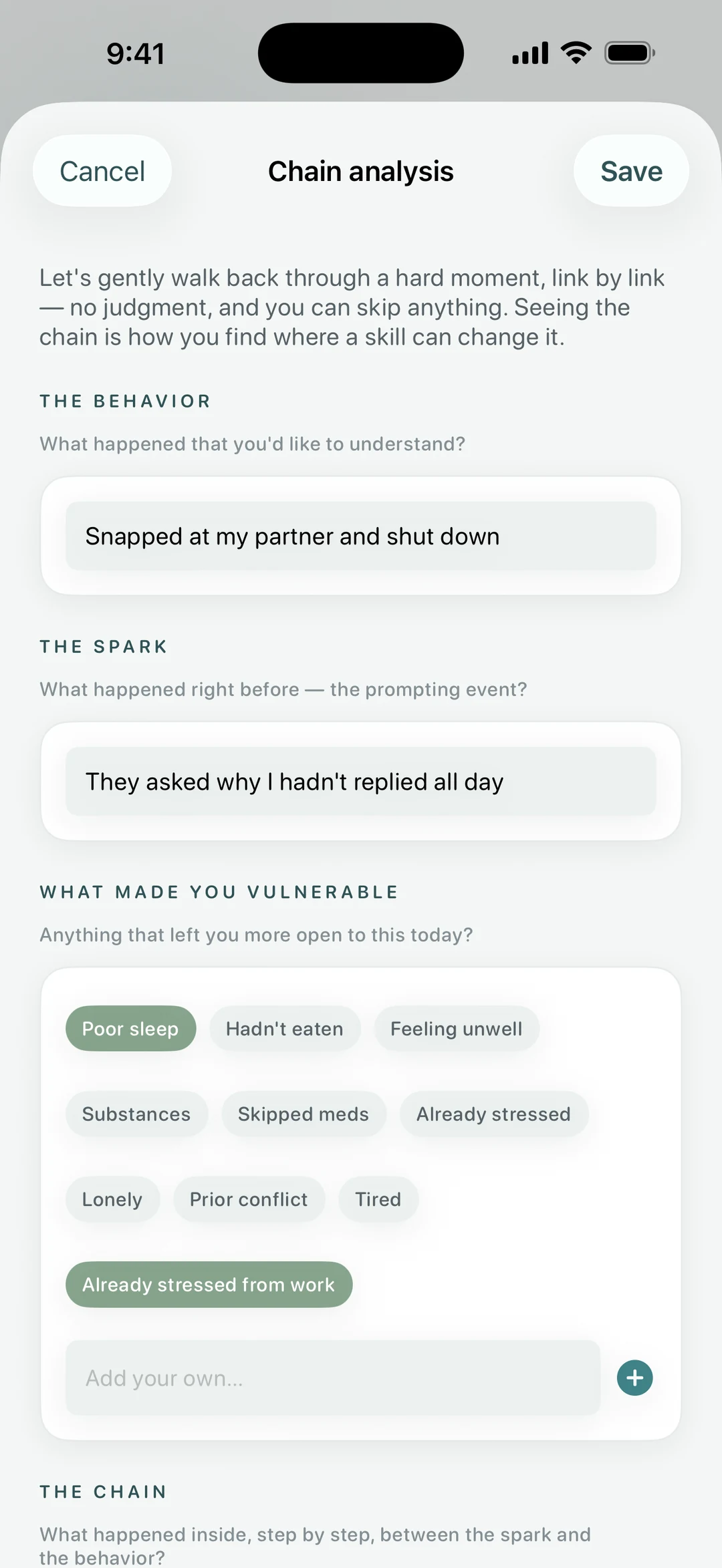
When a moment goes the way you didn't want, chain analysis walks you back through it, link by link, to the point where a skill could have changed things.
- The whole chain, in your words. The spark, what made you more vulnerable that day, then each thought, feeling, sensation, urge, and action that followed, laid out in order.
- Ends with a plan. Mark the skills that could change a link next time, and what you'd repair. Your companion brings that plan into your next conversation.
- Skip anything, keep everything. Every field is optional and nothing is graded. Your chains stay on your device and are yours to reopen, edit or delete.
- Then your companion writes back. Ask for a reflection and it reads your finished chain, then replies in its own voice, naming the link you found and the skill you picked. It doesn't use up your daily messages.
- The spark
- Vulnerable that day
- A thought
- A feeling
- A body sensation
- The link you can change An urge
- What you did
- Your plan
Crisis resources stay free.
Open Get help now from any main tab or during onboarding. The kit includes 988 (call or text, US), 741741 (text HOME), and regional resources. Bundled resources and grounding work offline; calls, texts and websites require service. Chat may offer resources when it detects danger, but detection can miss things. Quietoak is not an emergency service; if you are in immediate danger, call your local emergency number.
A generous free plan. Plus when you want more.
The skills, the diary card, all six companions, and the crisis kit are free. Plus adds more messages, a premium voice, and a PDF to share with your therapist.
Free
- Eighteen DBT skills across all four modules
- The one-minute diary card & gentle trends
- All six companions
- Saved conversations and companion memory
- 5 companion messages a day, with no limit on crisis help
- The Crisis Survival Kit, available offline
Quietoak Plus
US pricing. Local prices are shown in the app before purchase.
- Everything in Free
- 100 companion messages a day, on an upgraded AI model
- 30 chain-analysis reflections a day, up from 3
- A warmer, more natural premium voice for your companion
- A PDF of your diary cards and chain analyses to share with your therapist
A message with a photo uses three daily messages on either plan. The app shows when your allowance resets.
Crisis support is always free, on every plan.
In the iPhone app, Plus is an auto-renewing subscription. If you subscribe, it's billed to your Apple ID and renews unless cancelled at least 24 hours before the period ends; manage or cancel anytime in iOS Settings. See terms.
FAQ
Is Quietoak therapy?
No. Quietoak is a self-help app for practicing skills based on the DBT (Dialectical Behavior Therapy) model. It isn't therapy, a diagnosis, or a substitute for professional care. Use it alongside therapy, or to learn the skills on your own.
Is the companion a real person?
No. Your companion is an AI guide, and it says so. It never claims to be a therapist or a person, and it points you to people and professional help when you need them. It's there to help you practice skills, not to replace real support.
Can I talk out loud, or switch companions?
Both. Tap to start speaking and tap again to send. Your companion answers in a warm spoken voice, or you can stay in text. You can switch between the six companions for free, whenever you like, and each one keeps its own conversations and memories. A premium, more natural voice is part of Quietoak Plus.
What if I'm in crisis?
Get help now is available on every main tab and throughout onboarding, with help controls in voice mode and guided practice. The Crisis Survival Kit is free. Bundled resources and grounding work offline; calls, texts and websites require service. If you're in immediate danger, call your local emergency number. Quietoak is not an emergency service.
Is my data private?
Your diary and practice are stored on your device, and we keep no copy of your diary on our servers. There's no account and no login, and we don't run ads or third-party trackers on your diary or chat. To generate replies, your messages are sent to our backend and an AI provider, together with a short recap of your last 7 logged diary days (including your urge ratings and the first 120 characters of each day's note) so the reply fits your week. Saved conversations are linked to a random installation ID so they're there when you come back. Optional profile details you share, such as your name, can also be sent with your messages or included in saved memories. You can delete them anytime, and the full data flow is in our privacy policy.
What's free, and what's Plus?
Free includes the DBT skills library, the diary card and trends, all six companions, your saved conversations, the crisis kit, and 5 companion messages a day (a message with a photo counts as three). Quietoak Plus ($9.99/month or $59.99/year) raises that to 100 messages a day on an upgraded AI model, and adds a premium companion voice, a PDF of your diary cards and chain analyses, and 30 chain reflections a day instead of 3. The on-device voice stays free for everyone, and crisis support is never limited and never behind Plus.
Who is Quietoak for?
Adults (18+) who want a calm, private place to practice DBT skills: alongside therapy, while on a waitlist, or on their own.
iPad? Mac? Android?
iPhone first. The iPhone app runs on iPad in iPhone-compatibility mode for now; a native iPad layout, Android, and Mac aren't available yet.
Steady, even on the hard days.
Quietoak is coming to iOS. Email us and we'll let you know when it's out.
Email me at launchQuietoak teaches DBT skills and is not therapy, medical treatment, a diagnosis, or a crisis service. Your companion is an AI guide, not a person or a substitute for professional care. If you're in crisis, call or text 988 (US) or your local emergency number. 18+.